
Before there was a bungy jump, there was an engineering problem. The Tsitsikamma is cut by a series of deep gorges running down to the sea, and for most of the last two centuries they made travelling along this coast extremely difficult.
The bridge you jump from exists because of that problem. This is how it came to be there.
The old way down
When the Cape government began planning a coastal road between Port Elizabeth and Plettenberg Bay in the nineteenth century, the job went to Thomas Bain, the most accomplished road builder in the country.
Bain’s answer to a gorge was to go down into it and back out the other side. The Bloukrans Pass and its sister the Grootrivier Pass were hacked out of unstable shale slopes in high rainfall country, and they are still there today as part of the R102. They are beautiful and they are slow, which was the entire problem.
For nearly a century, crossing the Bloukrans meant descending several hundred metres and climbing back out. Modern freight and modern traffic needed something else.
Going over instead of down
The solution was to span the gorges rather than descend into them. Three big bridges were built to carry the new N2 freeway across the Grootrivier, the Bloukrans and the Storms River.
The Bloukrans Bridge was designed by Liebenberg and Stander and built by Concor between February 1980 and June 1983. The freeway itself opened in June 1984.
The numbers
- 216 metres above the Bloukrans River
- 272 metre central arch span
- 451 metres in total length
- Built in three years and four months
It remains the largest single span concrete arch bridge in Africa.
How you build an arch over a 216 metre drop
This is the part worth understanding, because it explains the shape you are standing on.
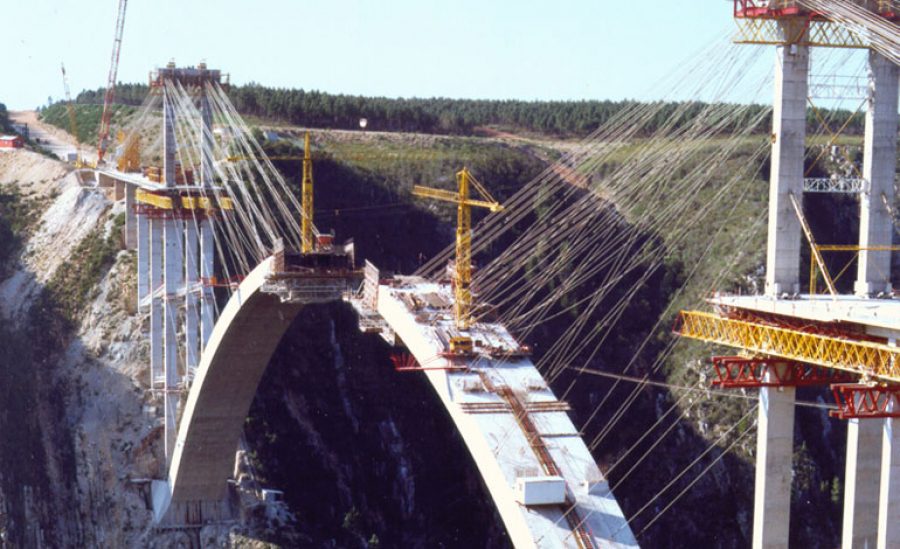
You cannot build scaffolding up from the bottom of a gorge that deep. So the arch was built outwards from both sides at once, in segments, with each new segment cast in place and held up by temporary steel cables running back to towers built on the cliff tops. The half arches crept towards each other across the void, suspended on cable stays, until they met in the middle.
Once the two halves were joined at the crown, the arch became self supporting, the temporary cables came off, and the columns and roadway were built on top of it.
The jump platform sits at the centre of that span. It is the point where the two halves met.
From road bridge to adventure site
In 1990, six years after the road opened, the Bloukrans became the first bridge in Africa used for bungy jumping.
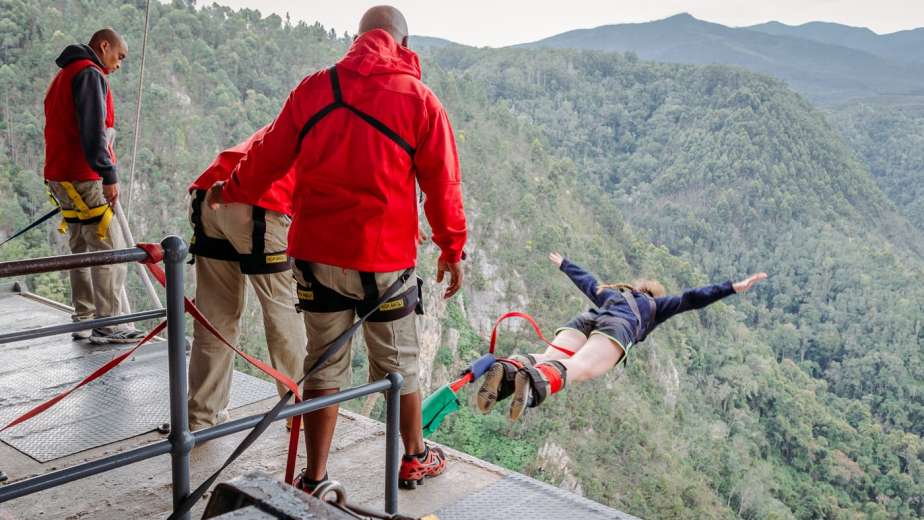
The commercial operation as it exists today began in December 1997, when Face Adrenalin established the jump from the centre of the arch. It has run continuously since, and for most of its history it held the title of the world’s highest commercial bridge bungy.
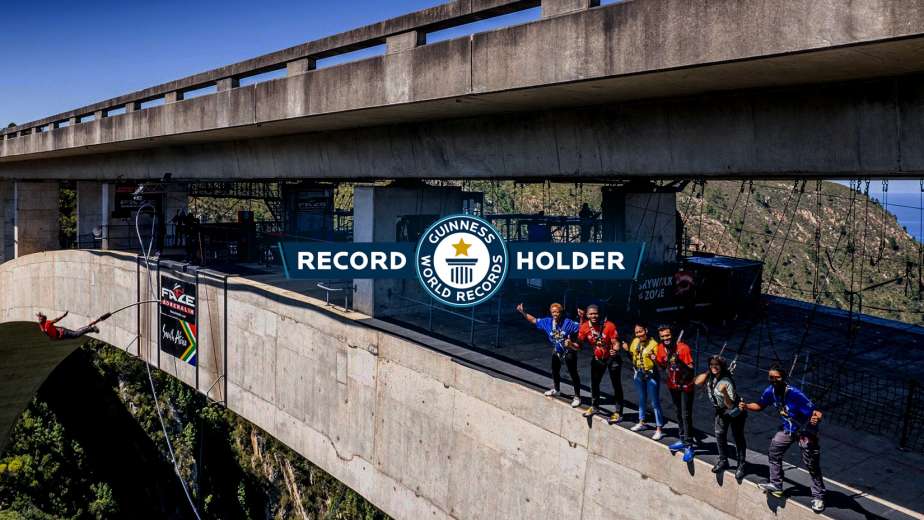
The site has since grown beyond the jump. The SkyWalk takes visitors along a catwalk beneath the arch to the platform, and the Zipline crosses 200 metres of the gorge. Six Guinness World Records have been set from the bridge.
What the bridge means locally
This part rarely makes the travel guides. The operation employs people drawn from the neighbouring communities of Coldstream, Thornham, Storms River, Covie and The Crags, and a share of turnover has gone to a local community trust since 1998.
A structure built to shorten a drive ended up becoming one of the larger employers in a rural part of the Eastern Cape border.
Standing on it today
Most people crossing the Bloukrans Bridge do it at 120 kilometres an hour without knowing what is underneath them. The ones who stop get to walk out beneath the roadway, stand at the centre of a 272 metre arch, and look 216 metres down at the river that made the whole thing necessary.
Read about our story, or book the Full Adventure Package and see it from underneath.



 Send message