
The Garden Route is the stretch of South African coastline between Mossel Bay and the Tsitsikamma, and it is the country’s most driveable adventure corridor. Roughly 300 kilometres of forest, gorges, lagoons and coastline, with the N2 running straight through the middle of it and something worth stopping for every half hour.
This is a guide to doing it properly, in the order you will actually drive it, travelling west to east from Cape Town towards Gqeberha.
How long you need
You can drive the Garden Route in a day. You should not. Five to seven days lets you cover the main stops without spending the whole trip behind the wheel. Ten days lets you add the inland detour to Oudtshoorn and slow down properly.
If you only have three days, base yourself in Plettenberg Bay. It sits close to the middle of the best section, and almost everything worth doing is within an hour’s drive.
Mossel Bay and George
Mossel Bay is the official western gateway. It is best known for shark cage diving, which runs year round and does not require a diving qualification.
George is the region’s main town and the location of its airport, which makes it the practical starting point if you are flying in rather than driving from Cape Town. From George you can take the Outeniqua Pass inland towards Oudtshoorn, which is worth doing for the Cango Caves and the ostrich farms if you have the days to spare.
Wilderness
A small town with a long beach and a network of lakes and rivers behind it. This is the place to get on the water. Canoeing up the Touw River to the waterfall is the classic outing, and the paragliding launch above the town is one of the more accessible tandem flights in the country.
Knysna
Built around a large tidal lagoon that opens to the sea between two sandstone cliffs known as the Heads. Drive up to the eastern Head for the viewpoint, take a ferry across the lagoon, and eat oysters, which the town is known for.
Knysna also sits at the edge of the indigenous forest that runs east from here, and there are good short walks and mountain bike trails in it.
Plettenberg Bay
Plett is the natural base for the eastern half of the route. Robberg Nature Reserve is the standout: a rocky peninsula with a circular hiking route, a seal colony, and some of the best coastal views on the Garden Route. Give it three to four hours for the full loop.
Full listings for the area are on Plett Tourism. The town is also home to a cluster of well run animal sanctuaries including Monkeyland, Birds of Eden and Jukani, which work well as a half day if you are travelling with children.
Nature’s Valley
Reached by turning off the N2 onto the old Groot River Pass, Nature’s Valley is a single small village sitting between forest, lagoon and an empty beach. There is very little to do there, which is the entire appeal. It is also the finishing point of the Otter Trail.
Bloukrans Bridge
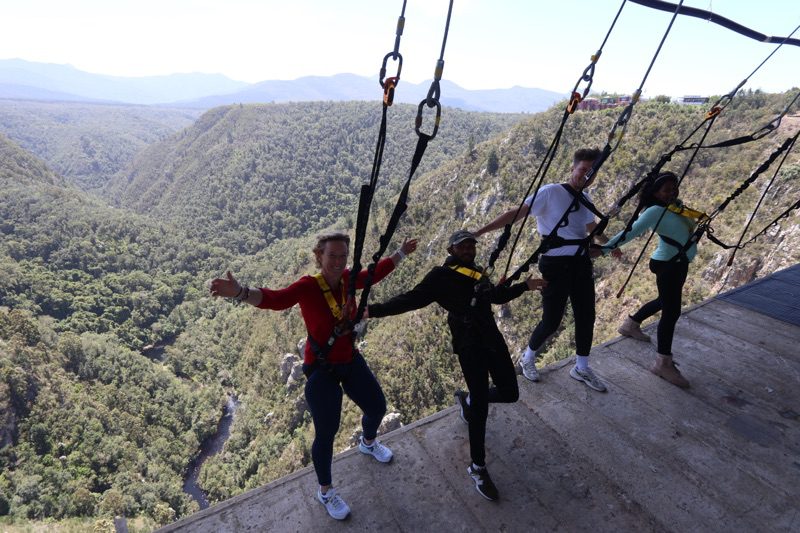
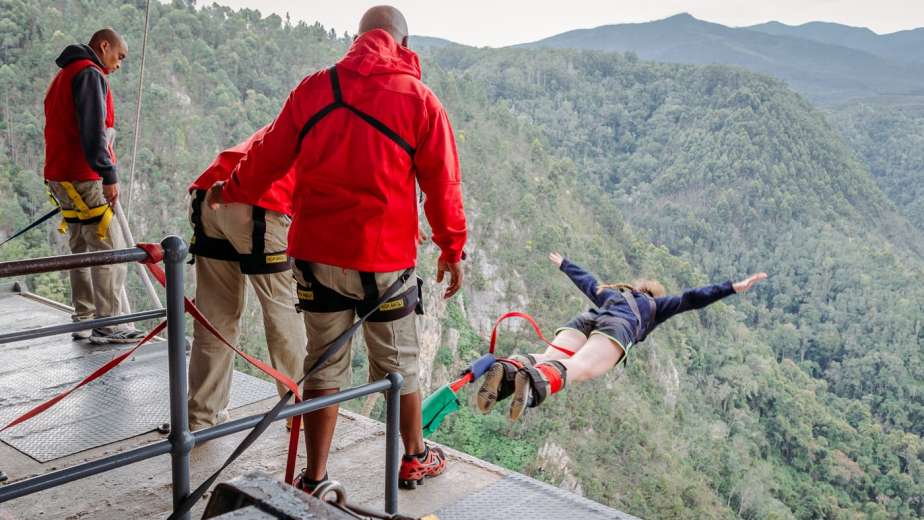
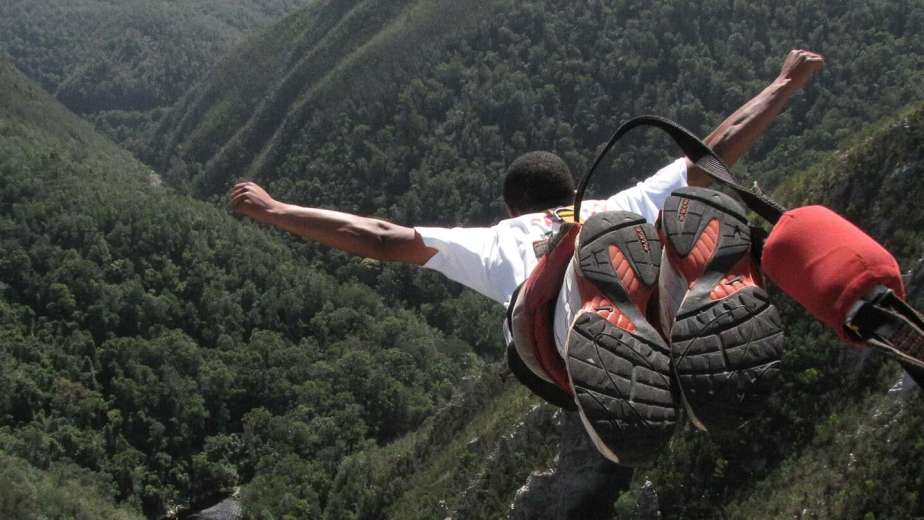
Twenty minutes past Nature’s Valley the N2 crosses the Bloukrans River on a concrete arch bridge 216 metres above the gorge. This is the highest bungy jump in Africa and the highest in the Southern Hemisphere, and it has been operating since 1997.
It is also more than a bungy jump. The SkyWalk takes you out along a catwalk beneath the arch to the centre of the bridge, and the Zipline runs 200 metres back across the gorge. You can do all three in one visit as the Full Adventure Package, which is how most visitors do it and the reason people build a whole morning around the stop rather than treating it as a photo break.
Drive times to the bridge:
- Plettenberg Bay: about 30 minutes
- Knysna: about 45 minutes
- George: about 1 hour 30 minutes
- Gqeberha: about 2 hours
Full directions and GPS coordinates are on the getting here page.
Tsitsikamma and Storms River
Just east of the bridge, Tsitsikamma National Park protects a long section of rocky coastline and indigenous forest. Storms River Mouth is the main attraction, with a short walk over three suspension bridges to the river mouth itself. The village of Storms River nearby has canopy tours through the forest and is the base for most of the area’s guided activities.
Jeffreys Bay and beyond
Jeffreys Bay is a serious surfing destination and Supertubes is one of the best right hand point breaks anywhere. Further east, Addo Elephant National Park is close enough to Gqeberha to work as the final stop, and it is malaria free, which makes it an easy Big Five option to attach to a coastal trip.
When to go
The Garden Route gets rain throughout the year, so there is no truly dry season, but there is also no bad time to visit.
- December to February is summer. Warmest weather, longest days, and by far the busiest period. Book well ahead.
- March to May is the sweet spot. Settled weather, warm sea, and far fewer people.
- June to August is winter. Cooler and quieter, and this is when southern right whales are along the coast.
- September to November brings spring, wildflowers and the tail end of whale season.
A sensible five day route
- Day 1: Cape Town to Mossel Bay or George.
- Day 2: Wilderness and on to Knysna.
- Day 3: Knysna to Plettenberg Bay. Robberg in the morning.
- Day 4: Bloukrans Bridge in the morning, Nature’s Valley or Storms River in the afternoon.
- Day 5: Tsitsikamma to Jeffreys Bay and Gqeberha.
Book the bridge for the morning. The light is better, the wind is usually lighter, and it leaves your afternoon open.



 Send message